Huayna Potosi Climb: A Guide To Summiting The 6000m Peak in Bolivia (2026)
- May 8
- 10 min read
Climbing Huayna Potosi had been on our radar since we arrived in Bolivia and standing on the 6,088m summit made every step worth it!
Your lungs scream wanting more oxygen as you dig in your crampons and steady your ice axe. The last 100m to the summit is steep, narrow and slow but as you emerge to the top the views are incredible. Lake Titicaca starts to glimmer in the morning light and the sun emerges from the horizon. The clouds are far below… you made it, the summit of Huayna Potosi, La Paz’s top thing to do!

Huayna Potosi in Bolivia is often called ‘the easiest’ 6000m summit, and although it’s accessible and you don’t need prior climbing experience, you need to be prepared - not everyone makes it.
This guide will share our experience of the 3 day, 2 night (base camp night + high camp night) tour for summiting the mountain, staying at Huayna Potosi Base Camp and everything you need to know before taking on this incredible climb!
Is Huayna Potosi Hard? (Experience & Fitness Required)
With the nickname the ‘easiest’ 6000m peak you might be fooled into thinking this a normal hike, you’d be wrong!
Although yes, in comparison to other 6000m peaks this climb is relatively easy. You still need to have a guide, crampons and good acclimatisation to mitigate altitude sickness.
After living out of a car for the last 7 months we’re not our fittest but managed the climb, one of the toughest sections for Kate was carrying the gear up and down from high camp. You have around 20kg of gear so be prepared for that.
The summit is tough due to the altitude and lack of oxygen, your guide will go slow but you can’t stop for more than 5 minutes due to the freezing conditions.


Acclimatisation Before Huayna Potosi
It is incredibly important to acclimatise before taking on this trek. We spent a while at high altitude as we explored the altiplano of Bolivia and Argentina plus spent a week in La Paz before we took on the climb.
Allowing yourself to acclimatise will give you a better chance of summiting. We met a guy who didn’t make it while we were at base camp (this was before we went and didn’t fill us with confidence) who only spent a day in La Paz (3,600m) beforehand and experienced bad altitude sickness forcing him to turn around 100m from the summit.
It’s recommended to spend 3-4 days at altitude before heading up Huayna Potosi to avoid altitude sickness. If you need some activities to do in the city while you acclimatise we can recommend Paragliding and Mountain Biking.

Where Is Huayna Potosi?
Huayna Potosi sits in the Cordillera Real mountain range in western Bolivia, just 2 hours north of La Paz. At 6,088m it is one of the most accessible 6000m peaks in the world, drawing climbers from across the globe. With Lake Titicaca visible from the summit and the dramatic Bolivian Andes surrounding you, it's easy to see why it has become one of the most popular climbs.

How To Get To Huayna Potosi From La Paz?
The easiest way to reach base camp is by booking a tour. We went with Andean Peaks and met at their La Paz office before taking a minivan up to the mountain. The drive only takes 2 hours and the cost is included in the tour price.
Overlanders: If you have your own car then it’s possible to drive to base camp and meet your tour there, allowing you to continue your trip straight after the climb without having to return back to La Paz. We wanted to do this, however our car, Yoti, had broken down so we opted to take the minivan.
The Itinerary: 3 Days, 2 Nights
Day 1: Base Camp & Ice Wall Climbing
We met Andean Peaks at their office at 8:30 to try on gear and pack our bags.
Tip - choose a slightly larger boot to allow for two socks and avoid blisters!
Once our bags were packed (more on what to bring below) we hopped in the minivan for the two hour drive to Huayna Potosi base camp at around 4700m.
After we arrived at base camp we chose our bunks and enjoyed lunch - we needed the fuel as we were about to go ice climbing and practise our technical skills ready for the climb.
The walk to the ice wall takes around 45 minutes, and you can already feel the effects of the altitude.
Once we reached the glacier our guides helped us put on our crampons and showed us how to manoeuvre our ice axes correctly into the wall.

We spent a couple of hours practising with the crampons, ropes and axes. It’s important to keep the rope tight in case someone falls, plus there’s always the risk of crevasses.
At the end of our session we got to scale a vertical wall, this is tough going and gives you an appreciation for the guides who make it look easy!
We returned to camp, enjoyed beef pasta for dinner and got ready for bed early ready to climb high camp tomorrow.


Day 2: Huayna Potosi High Camp
Day two starts off slow! You enjoy breakfast and pack your bags.
Packing your bags correctly is important, to help with the climb. Put heavy items at the bottom or middle of your pack and keep snacks accessible.
Our guides gave us the gear we needed to carry up, and trust us it’s not light! We had our personal items plus an ice axe, harness, helmet, crampons and the heaviest item, our ice boots!
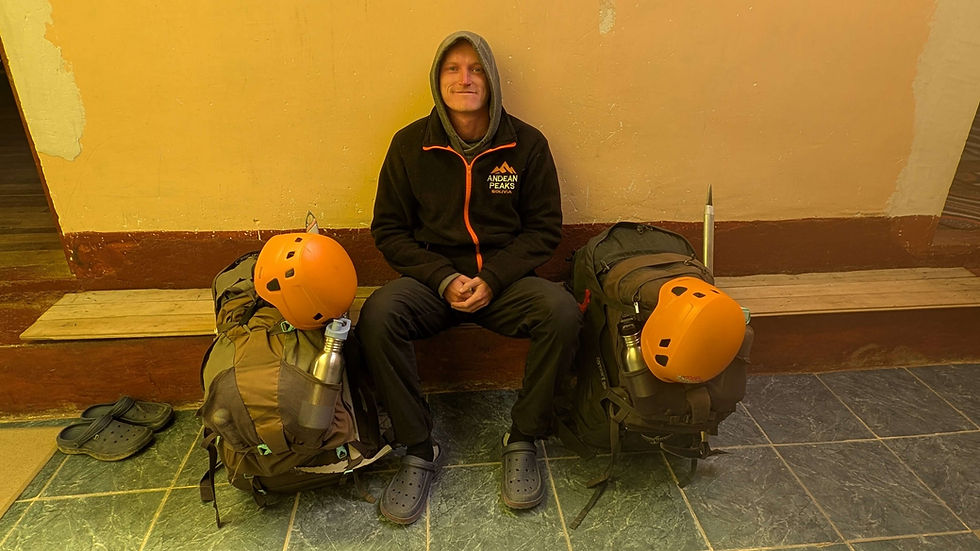
Once we were packed we enjoyed lunch before heading on the 3 hour climb to high camp. The guides set the pace and it’s slow but we were thankful as our shoulders started to feel heavy and the steady incline turned into a vertical climb up stone steps.
When you reach the yellow steps, dangling precariously over the edge of the mountain you’re nearly there!
Huayna Potosi High camp was way better than we expected, considering it’s at 5,300m. We had a toilet, bunk beds and a delicious dinner of Milanesa cooked freshly by our guides. Also we constantly had hot water ready for a hot chocolate or Mate Tea.
The view here is also spectacular so we brushed our teeth overlooking mountains and headed to bed at 6:30pm… ready for a big day tomorrow.

Day 3: Huayna Potosi Summit
Our alarms rang at 12:30am and through bleary eyes we pulled on four layers of clothing, plus a balaclava, two pairs of gloves and socks, a harness and our ice boots.
We had fruit cake as a small breakfast then headed outside down to the snow line. Here in the pitch black, our guides tied on our crampons.


Guided just by the light of our head torches we began the climb.
Through the darkness you can’t estimate time or distance, all you know is you have to put one foot in front of the other.
The higher we got the harder it became and we needed to take small breaks. Other torches lit up the path, highlighting how far was still to go.
As the first rays of sun appeared we faced the last 100m. The steepest and narrowest section. Alongside our guide we dug our axes in with strength and continued to the summit.
After 5 hours of climbing and just as the sky lit up we had reached the summit of Huayna Potosi!

Standing on the Huayna Potosi summit at 6,088m, high above the clouds with the Cordillera Real stretching out below us, it was otherworldly.
After 15 minutes at the summit and chilled to the bones as it was -10°C we headed back down.
In the light of the day you realise the feat you’ve just undertaken. The path seems steeper and you’re glad that the crampons as crevasses make themselves known and the views of the Cordillera Real come into focus.

It takes a couple of hours to get back to Huayna Potosi High Camp where you shed your layers and enjoy warming tea.
The trek is not over though… you still have to walk 2 hours back down to Huayna Potosi Base Camp. This was tough, you’re tired, 20kg weighs on your shoulders and you need to navigate steep rocky terrain.
We were so thankful our guides offered to carry some of the weight, this was only possible due to Andean Peaks small group sizes.
Back at base camp we demolished a sandwich and took the minivan back to La Paz. Time for a nap!
After the climb you'll deserve a rest, why not head to the Amazon next!

What To Pack For Huayna Potosi
The key here is to pack light! Your guides will load you up with around 20kg of gear, so keep your personal pack as light as possible.
What we packed for Huayna Potosi:
Head Torch (possible to rent)
Hiking Shoes (possible to rent)
Warm Jacket
Fleece
Thermal Layers
Walking Trousers
Two pairs of warm socks
Inner Gloves
Toilet Paper
Snacks (Sweets, chocolate)
Hiking poles (possible to rent)
Toiletries (deodorant, toothbrush & toothpaste)
Altitude Sickness Medication (Diamox)
Battery Pack
Phone/Camera
Suncream/Lipbalm
Sunglasses
Water Bottle
50 bolivianos for entrance fee
Tips for guides
What was provided by Andean Peaks for Huayna Potosi:
Crampons
Helmet
Harness
Ice Axe
Extra Fleece
Outer Jacket
Outer Trousers
Balaclava
Warm Gloves
Our Experience With Andean Peaks
We decided to climb Huayna Potosi at the last minute and ended up booking at their office in La Paz after enjoying a coffee next door at Blessed Coffee. Their office is located in the centre of the city, making it super convenient for backpackers.
The main reason we chose Andean Peaks was the small group sizes, we loved the idea of having a smaller group that we could get to know and tackle the mountain together. We’d heard stories of groups of 20+ where you get no sleep the night before in the shared dorm.
We had three of us in our group and two guides. This was perfect as we were all on the same level, we wanted to get to the top and we’d happily hit the hay at 7pm if that’s what it took! It also paid off as on the way down our guides offered to carry our bags - this definitely wouldn’t happen in a larger group.
Our guides spoke English and safety was their priority. We were told we could turn back if we felt ill and communication was key.
The other reason we loved Andean Peaks was that at base camp we got a proper bunk bed, this isn’t the case with all tours and delicious meals throughout!


Booking Huayna Potosi & Cost of Huayna Potosi
You can book your tour with Andean Peaks at their office or online through GetYourGuide. For updated costs send a WhatsApp message to +591 70193201
One thing we would say is you get what you pay for. We had proper beds (not mats on the floor), a small group and freshly cooked meals.
Best Time To Visit Huayna Potosi
We climbed in April and had perfect weather, but timing your climb right makes a big difference.
The best time to climb Huayna Potosi is during the dry season, which runs from May to October. During these months you'll have the most stable weather, clearest skies and best summit visibility. June, July and August are peak months and the mountain will be busiest.
The wet season runs from November to April, bringing afternoon storms, reduced visibility and icier conditions on the glacier. That said, we climbed in April (the shoulder season) and had brilliant conditions. The wet season doesn't guarantee bad weather, it just means more unpredictability.
Every season will be cold at the top around -10°C to -20°C! The biggest factor here is the wind chill and that will determine how long you can stay at the summit.
Our tip: We enjoyed climbing in shoulder season as even though it was busy we didn’t have to wait in a queue. We heard in the peak season there can be long queues to reach the summit.

Huayna Potosi FAQs
Is Huayna Potosi dangerous?
As with all climbs and adventure there is an element of risk. You need to be physically fit, but with a guide safety is paramount. There have been fatalities on Huayna Potosi, which is why climbing with a licensed guide is non-negotiable.
Do I need experience to climb Huayna Potosi?
No experience with climbing is needed, the guides will teach you how to use the crampons and ice axe.
How long does it take to climb Huayna Potosi?
Tours range from a 2 day 1 night option to our recommended 3 day 2 night itinerary. The latter will give you a better chance of summiting as you can acclimatise and practise skills. From base camp to high camp it takes 2-3 hours and from high camp to the summit the climb is 5-6 hours.
How cold is Huayna Potosi summit?
It varies due to windchill but can get to -20°C. We were lucky with the weather, around -10°C and we were very glad of the four layers we were wearing.
How long should I acclimatise before climbing?
The longer the better really! We spent over a week in La Paz before attempting the climb.
Is there electricity on Huayna Potosi?
At base camp you’ll find power, meaning you can charge your phone but once you leave base there’s no signal or WiFi. At high camp you’ll need a battery pack .
Final Thoughts on Climbing Huayna Potosi
Climbing Huayna Potosi was one of the highlights of our entire South America trip. Standing on that summit at sunrise was a feeling you can’t describe. If you're in La Paz and wondering whether to do it, stop wondering. Book it. We couldn't recommend Andean Peaks highly enough! Looking for more adventures in La Paz? We can recommend Paragliding and Mountain Biking.

Travel Tools To Help You Plan
These are some of the travel tools we love and use daily, by booking through our links you support our blog and help us grow, thank you.
Thank you for reading and enjoy your Bolivian adventure. Reach out to us over on Instagram @KateandMikesTravels. We always love to hear from people who read our blogs!
* We were kindly gifted part of the Huayna Potosi Tour with Andean Peaks although all opinions are our own.


.png)


Comments